
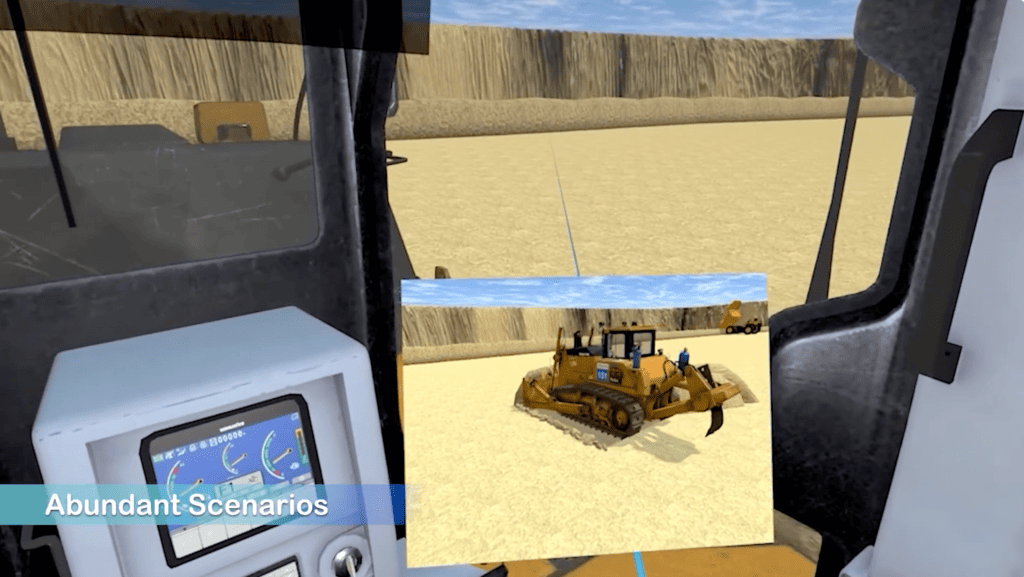
Indonesia’s open-pit mining operations deploy some of the largest mobile equipment fleets in the world. A single mid-tier coal contractor operates upward of 400 dump trucks and 35 excavators simultaneously across haul distances exceeding 5 kilometers (AlamTri/SIS, 2023). Major contractors like BUMA (PT Bukit Makmur Mandiri Utama) manage approximately 3,500 equipment units; Kaltim Prima Coal’s Sangatta operation alone runs 137 haul trucks alongside 20 hydraulic shovels (Mining Technology, 2020). Yet the dominant fleet monitoring paradigm — two-dimensional dashboards displaying vehicle positions as colored dots on flat maps — compresses this three-dimensional operational reality into an abstraction that discards the spatial context upon which critical decisions depend. This article examines the architecture, evidence base, and applied implementation of digital twin technology as a fleet-scale monitoring platform capable of rendering 100 or more mining vehicles in a single, spatially accurate 3D environment. The analysis draws on peer-reviewed literature, Indonesian mining operational data, fleet management system benchmarks, and the applied case of Virtu’s digital twin deployment for Petrosea’s coal mining operations in Kalimantan. Findings establish that 3D digital twin dashboards deliver measurable improvements in situational awareness, congestion detection, dispatch optimization, and predictive maintenance response — capabilities that translate to documented downtime reductions in the range of 35–50%.
Introduction: The Visibility Problem at Fleet Scale
There is a control room somewhere in East Kalimantan right now — probably inside a prefabricated building at the edge of an open pit — where a dispatcher is staring at a screen full of numbers.
Each number represents a truck. A Komatsu HD785, or a Caterpillar 789, or a Hitachi EH4000 — each hauling 100 to 200 tonnes of overburden or coal per cycle, each burning through hundreds of liters of diesel per shift, each costing the operation between USD 5 and 12 per minute to run. The dispatcher’s screen tells them where each truck is. It tells them which trucks are loaded and which are empty. It tells them cycle times and queue lengths expressed as columns in a table.
What the screen does not tell them is what is actually happening.
It does not show that three trucks are converging on the same intersection from different haul roads, creating a collision risk that will not appear in any spreadsheet until after someone gets hurt. It does not show that rainwater has pooled across a section of the main haul road, forcing trucks to decelerate by 30% — a condition that propagates queue delays upstream to every loading face served by that road. It does not render the fact that the pit geometry has changed since the last blast cycle, and that the planned route now passes dangerously close to an unstable bench.
This is the visibility problem at fleet scale. Indonesian coal mines routinely deploy fleets of 100 to 400+ vehicles across operational areas spanning tens of square kilometers. Kalimantan alone generated 42.43% of Indonesia’s mining equipment demand in 2024 (Mordor Intelligence, 2025). The Adaro Group’s mining subsidiary SIS operates more than 2,600 heavy equipment units and controls over 35 excavators and 400 dump trucks in real time through a digital fleet management system covering haul distances exceeding 5 kilometers (AlamTri, 2023). Hexagon’s Mining division deployed 176 units of its OP Pro fleet management system across multiple sites for PT Antareja Mahada Makmur — a subsidiary of Indonesia’s third-largest mining contractor (Hexagon, 2022).
These are not niche deployments. They represent the operational baseline for a sector that the Indonesian government has approved to produce 917 million metric tonnes of coal in 2025 alone (S&P Global, 2024). And every one of these operations faces the same fundamental limitation: fleet management systems that track hundreds of vehicles but render them in two dimensions, stripping away the spatial intelligence that determines whether those vehicles operate efficiently, safely, and profitably.
Theoretical Framework: Why Dimensions Matter
The Cognitive Cost of Dimensional Reduction
When a fleet management system displays a 120-tonne haul truck as a green dot on a flat map, it performs an act of dimensional reduction. The truck’s three-dimensional reality — its position in physical space, its relationship to terrain gradient, its vertical proximity to bench edges, its elevation relative to water drainage patterns — is compressed into two coordinates: latitude and longitude.
For a dispatcher managing 10 vehicles across a contained area, this compression is manageable. The dispatcher can hold the mental model of the site in working memory and reconstruct the third dimension from experience. For a dispatcher managing 100 to 400 vehicles across an active mining complex with continuously changing topology, the cognitive load of that reconstruction overwhelms human processing capacity.
Research published in Sensors (MDPI, 2025) on multi-layer digital twin frameworks for mining environments establishes that effective operational decision-making requires accurate geometry of the real physical asset, real-time monitoring capability, anomaly prediction capability, and scenario simulation capability — all of which depend on three-dimensional spatial fidelity. A two-dimensional dashboard can represent positions. It cannot represent the relationships between positions — and in mining, relationships kill people.
The Three-Layer Digital Twin Architecture
A mining digital twin capable of fleet-scale monitoring operates across three functional layers:
Layer 1: Terrain Digitization. The physical mine environment — pit geometry, haul road network, bench heights, waste dump profiles, drainage patterns, infrastructure positions — is captured through aerial survey (drone-mounted LiDAR and photogrammetry) and converted into a high-resolution 3D topographic model. This model is not static. It updates progressively as mining advances change the site topology — every blast cycle alters the terrain, every shift of overburden redraws the haul road profile.
A comprehensive review published in ScienceDirect (2024) confirmed that while digital twins for individual mining subcomponents (fleet management, drilling optimization, predictive maintenance) have advanced significantly, full-scale integration across the entire mining value chain remains rare. The terrain digitization layer addresses this gap by providing a unified spatial foundation upon which all operational data can be overlaid.
Layer 2: Fleet Data Integration. Real-time telemetry from onboard sensors and Fleet Management Systems (FMS) is ingested and mapped onto the 3D terrain model. Each vehicle is rendered as a live entity displaying its precise location, route trajectory, speed, operational status (loaded, empty, queued, idling, under maintenance), and equipment health indicators. The data originates from the IoT sensors already installed on modern mining equipment — GPS receivers, engine control modules, vibration sensors, hydraulic pressure monitors, fuel flow meters, and tire pressure systems.
Fleet management technology in mining has evolved dramatically since Komatsu first developed the concept in 1990 (ScienceDirect, 2024). Today’s systems — from Komatsu’s Modular ecosystem to Hexagon’s OP Pro to Model Mining’s SimpleFMS — collect granular cycle data at resolutions sufficient for digital twin rendering. The digital twin layer does not replace these systems. It spatializes them — translating tabular data into three-dimensional operational context.
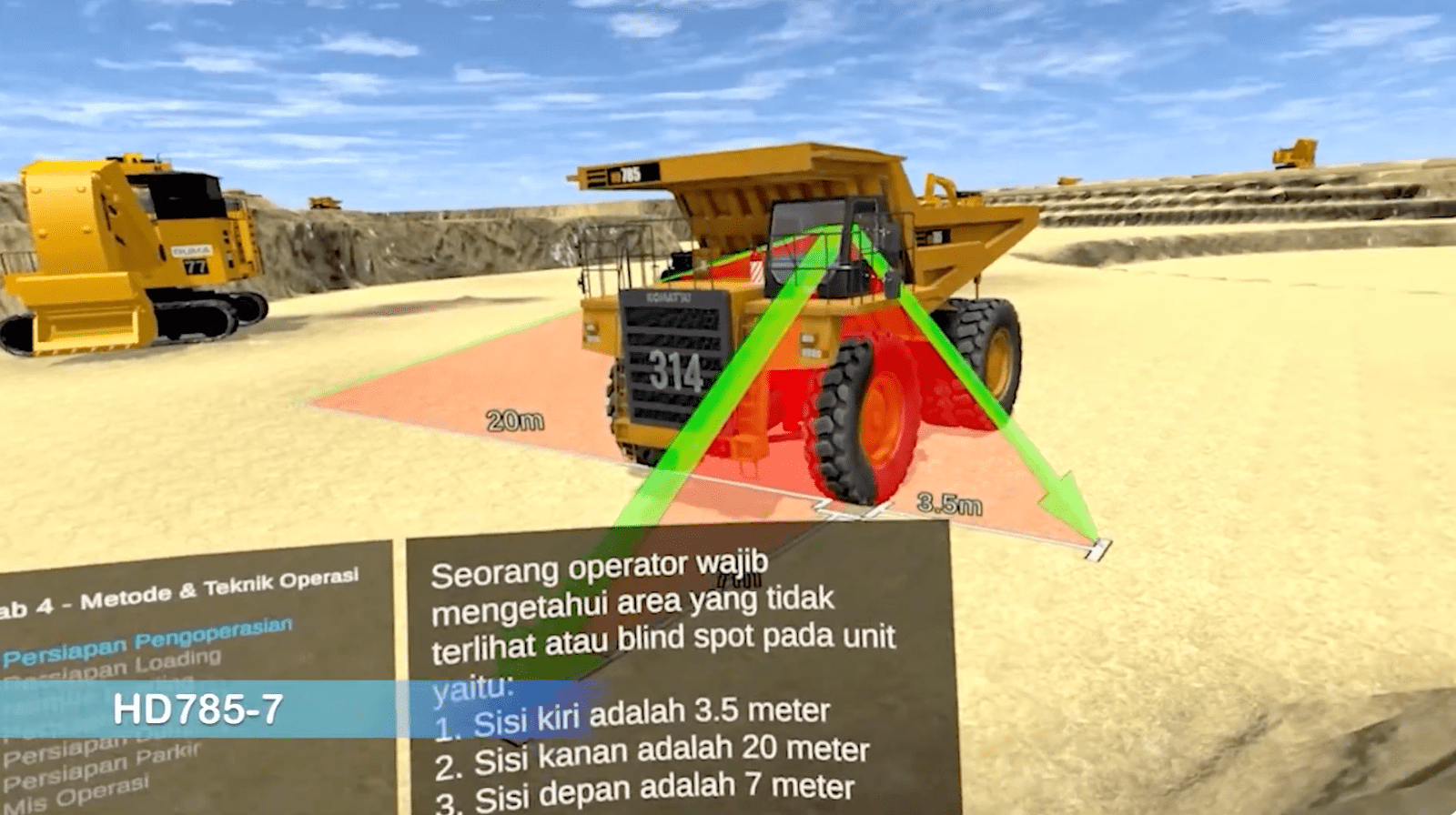
Layer 3: Human Interface. The combined terrain-plus-fleet model is delivered to operators, dispatchers, supervisors, and strategic planners through purpose-matched interfaces — web dashboards for command center dispatchers, mobile applications for field supervisors, and VR/Mixed Reality interfaces for immersive strategic review. The 3D rendering allows users to navigate the virtual mine at any scale: bird’s-eye overview of the entire operation, section-level view of a specific haul road segment, or ground-level inspection of a loading face queue.
Quantitative Evidence: What 3D Monitoring Delivers
Congestion Detection and Dispatch Optimization
A substantial portion of mining productivity loss originates not from equipment failure but from fleet interaction inefficiency — trucks queuing at loading faces, bunching at intersections, following suboptimal routes as pit geometry changes, and idling during poorly coordinated shift transitions.
SIS’s implementation of a digital fleet management system at Adaro Indonesia’s operations quantified these effects directly. The system — controlling 35+ excavators and 400+ dump trucks in real time — tracked loading time, cycle time to disposal areas, dumping time, and truck spotting time across every unit. The reporting enabled continuous identification of operational deviations and performance gaps. One measurable result: the system reduced the required truck fleet by 15 units since October 2023 by optimizing utilization rates, while simultaneously reducing excavator hanging time — the idle period when excavators wait for trucks to arrive for loading (AlamTri, 2023).
For a typical Indonesian coal operation, each unnecessary truck in the fleet represents millions of dollars in annual capital, fuel, maintenance, and operator costs. Reducing fleet requirement by even 5–10% through better dispatch intelligence delivers ROI that dwarfs the monitoring system investment.
A 3D digital twin amplifies these gains by rendering congestion patterns spatially. A color-coded haul road — green for free flow, yellow for slowing, red for queue formation — communicates actionable intelligence in a single glance. A two-dimensional table showing cycle time deviations across 100 trucks requires minutes of analysis to identify the same pattern.
Predictive Maintenance and Downtime Reduction
The U.S. Department of Energy reports that predictive maintenance strategies reduce equipment downtime by 35–45% and maintenance costs by 25–30% compared to reactive approaches. McKinsey analysis corroborates these figures, noting up to 40% maintenance cost reduction and 50% reduction in unplanned downtime through IoT-driven predictive maintenance.
A 2025 study published in IJCESEN demonstrated that AI-driven predictive maintenance using digital twin technology achieved a 35% improvement in predictive accuracy, 40% reduction in unplanned downtime, and 25% optimization in maintenance costs.
In the Indonesian context, PT Indo Muro Kencana (IMK) in Central Kalimantan connected 52 articulated haulers and 7 crawler excavators to an IoT-based remote monitoring system in November 2021 — the largest connected fleet in Indonesian mining at the time (Volvo CE, 2024). The system’s AI algorithm monitors all error codes and alarms transmitted from machines to the cloud, prioritizing alerts by urgency and severity. Result: technicians can address small issues before they escalate, always prepared with the right tools and spare parts.
When this maintenance intelligence is rendered within a 3D digital twin, the diagnostic context expands dramatically. A dispatcher sees not just that “Truck 47 has elevated hydraulic temperature” but that Truck 47 is currently halfway through a 3.8-kilometer haul on a 12% grade with a full load — a context that changes the urgency calculus entirely compared to the same alert on a truck idling at the workshop.
Safety and Proximity Awareness
Ministry of Energy and Mineral Resources (ESDM) data for 2024 shows that mining accidents in Indonesia are dominated by landslide incidents at 25.58% and inter-unit interactions at 18.60%. The fatality rate in the mineral and coal mining sector remains 0.017–0.022 per one million working hours — significantly higher than Australia (0.013) and Canada (0.008) (Kompas, 2025).
Inter-unit interaction accidents — collisions, near-misses, right-of-way conflicts — are fundamentally spatial events. They occur because two or more vehicles occupy the same space, or nearly the same space, at the same time. A 3D digital twin renders every vehicle’s position, trajectory, and speed in real time within the actual terrain geometry. Convergence risks become visible before they become incidents.
Manual (non-autonomous) fleets still hold a 65.11% share of Indonesia’s mining equipment market (Mordor Intelligence, 2025). For these operations — where human operators make every driving decision — the dispatcher’s ability to detect and communicate spatial conflict through a 3D interface represents a safety layer that no amount of radio communication or rearview cameras can match.
Terrain-Aware Route Optimization
Open-pit mining topology changes constantly. Every blast cycle reshapes the bench geometry. Every shift of overburden alters the haul road profile. Tropical rainfall — intense and frequent across Kalimantan and Sulawesi during the monsoon — degrades road surfaces within hours.
A static haul road plan, designed in a mine planning office and distributed as a printed map, becomes inaccurate within days of creation. A digital twin updated with progressive terrain data from drone LiDAR surveys maintains spatial accuracy continuously, enabling route optimization that responds to real conditions rather than planned assumptions.
For mines where haul distances exceed 5 kilometers — as at Adaro Indonesia’s SIS-managed operations — even marginal route optimization across hundreds of truck cycles per shift compounds into measurable fuel savings, reduced tire wear, faster cycle times, and lower maintenance expenditure.
Applied Evidence: Virtu’s Digital Twin for Petrosea
Project Context
PT Petrosea Tbk — a mining services company with over 53 years of experience in Indonesia — has implemented Industry 4.0 technology through its Minerva Digital Platform across mining operations. Petrosea’s portfolio spans coal projects across East and South Kalimantan, nickel operations in North Maluku, and infrastructure services reaching Central Papua. The company was selected by the World Economic Forum into the Global Lighthouse Network for its digital transformation — the only mining company and the only Indonesian-owned company to receive this recognition.
Petrosea’s SAP-based enterprise transformation — which earned the “Services Supernova” award in the mining category at the SAP Innovation Awards 2023 (CIO.com, 2023) — provided the data infrastructure foundation upon which Virtu built the digital twin visualization layer.
Implementation Methodology
Virtu — an Indonesian immersive technology company headquartered in Jakarta — developed Petrosea’s digital twin through a structured three-phase approach:
Phase 1: Terrain Digitization via Drone LiDAR. Virtu deployed drone-mounted LiDAR sensors to generate high-resolution 3D topographic maps of Petrosea’s active mining areas. LiDAR (Light Detection and Ranging) emits laser pulses that bounce off terrain surfaces and return to the sensor, creating point clouds with centimeter-level accuracy. These point clouds are processed into terrain meshes that serve as the spatial foundation of the digital twin.
The choice of drone-based LiDAR is specifically advantageous for Indonesian conditions. Conventional ground surveys across vast, remote mining areas in Kalimantan consume weeks of field time and face access challenges from terrain, weather, and logistics. Drone LiDAR surveys the same area in days, with accuracy that meets or exceeds ground-based methods. Progressive re-survey enables the terrain model to be updated as mining advances change the pit geometry.
Phase 2: Fleet Management System Integration. Real-time data from Petrosea’s existing Fleet Management System was overlaid onto the 3D terrain model. Each vehicle in the fleet — haul trucks, excavators, dozers, graders, support vehicles — was rendered as a live 3D entity displaying its precise location, heading, speed, load status, and operational state. The integration leveraged connectivity infrastructure already established at Petrosea’s sites for their ERP and telematics systems.
The FMS integration transforms the digital twin from a static terrain model into a living operational mirror. When a haul truck moves from a loading face to a disposal point, the virtual truck moves in real time across the virtual terrain, following the actual route, at the actual speed, with the actual load status. The dispatcher sees not a dot on a map but a truck on a road — with all the contextual information that implies.
Phase 3: Multi-Platform Delivery. Virtu deployed the digital twin across three interface layers matched to different operational roles:
- Web application for command center dispatchers who need continuous, screen-based oversight of the full fleet
- Mobile application for field supervisors who need situational awareness while physically on site
- Mixed Reality (VR/MR) interface for mine managers and planners who need immersive, walkable access to the virtual mine for strategic review, scenario planning, and stakeholder presentations
Capabilities Achieved
The Virtu-Petrosea digital twin delivered several fleet-monitoring capabilities directly tied to operational performance:
Real-time fleet visualization at scale. The entire active fleet — well over 100 vehicles — rendered simultaneously in a single 3D environment. Dispatchers could comprehend fleet distribution, identify clustering, and detect spatial anomalies that tabular dashboards could not reveal.
Automated congestion detection. Haul road sections where vehicle speeds consistently dropped below threshold levels were automatically identified and visually coded within the 3D environment. This enabled proactive rerouting before queue formation — critical in Indonesian conditions where tropical rain changes road surfaces within hours.
Predictive topology modeling. The terrain model incorporated forward-looking excavation projections based on the mine plan, allowing planners to anticipate haul road degradation and schedule maintenance grading before road conditions affected fleet performance.
Contextualized equipment status. Vehicle health alerts were not displayed in isolation — the standard approach in conventional telematics dashboards — but rendered within the spatial context of the mine. A hydraulic temperature warning on a truck climbing a 12% grade with a full load carries different urgency than the same warning on a truck parked at the workshop. The 3D context makes this distinction immediately visible.
Immersive strategic review. Through the VR/MR interface, senior decision-makers could virtually “enter” the mine at any scale — from a satellite-level overview of the entire concession down to ground-level inspection of a specific haul road segment or loading face queue. This capability proved particularly valuable for stakeholder communication and investment review presentations.
Significance for Indonesia
The Virtu-Petrosea deployment demonstrated three principles with national-sector implications.
First, digital twin fleet monitoring at this scale can be developed and deployed by an Indonesian technology company for Indonesian mining conditions. This is not a capability that must be imported.
Second, the system integrates with existing fleet management infrastructure rather than replacing it. Indonesian mining operations have invested heavily in FMS from Komatsu, Hexagon, Caterpillar, and other vendors. Virtu’s digital twin sits on top of these systems, spatializing their data without requiring fleet-wide hardware replacement.
Third, multi-platform delivery addresses the connectivity heterogeneity that characterizes Indonesian mining operations — where some sites have robust telecommunications infrastructure while others remain satellite-dependent. The same digital twin content is accessible across VR headsets, tablets, and web browsers, adapting to whatever infrastructure each site supports.
Implementation Challenges in the Indonesian Context
Connectivity and Latency
Real-time fleet monitoring in a 3D environment requires continuous data flow from onboard sensors to cloud-based processing engines and back to user interfaces. Indonesian mining sites in interior Kalimantan and Sulawesi face connectivity limitations that vary dramatically by location. The Palapa Ring fiber backbone has extended coverage, but many mine sites still depend on VSAT (Very Small Aperture Terminal) satellite links with latency measured in hundreds of milliseconds.
Edge computing architectures — where initial data processing and 3D rendering occur locally at the mine site — mitigate latency constraints. Sensor data is aggregated, processed, and rendered at the edge, with periodic synchronization to cloud-based analytics platforms when bandwidth permits. PT Telin and Citra Connect’s planned deployment of 200 additional ground stations by 2026, including support for mining operations, signals improving infrastructure coverage (Mordor Intelligence, 2025).
Heterogeneous Fleet Integration
Indonesian mining operations use equipment from multiple manufacturers — Komatsu, Caterpillar, Hitachi, Volvo, Liebherr, and increasingly Chinese brands like Sany and XCMG (Mordor Intelligence, 2025). Each manufacturer uses proprietary telematics protocols and data formats. Integrating data from 100+ vehicles across three or four different OEM systems into a single digital twin requires flexible middleware capable of translating heterogeneous data streams into a unified format.
Mordor Intelligence reports that vendors are increasingly differentiating through open-architecture software that can overlay mixed-OEM fleets — precisely the capability required for digital twin integration in the Indonesian multi-brand equipment environment.
Tropical Environmental Stress
LiDAR drones, IoT sensors, and VR headsets all face accelerated degradation in tropical mining environments. Laterite dust — the fine, iron-rich particulate matter ubiquitous in Indonesian nickel and coal operations — infiltrates electronic enclosures. Humidity corrodes connectors. Vibration loosens mountings. Temperature fluctuations stress solder joints.
Hardware deployed in these conditions requires IP-rated enclosures, enhanced cooling systems, compressed maintenance intervals, and ruggedized specifications that exceed consumer-grade standards. The operational cost of these environmental adaptations must be factored into total implementation budgets.
Workforce Digital Readiness
The transition from 2D tabular dashboards to 3D spatial interfaces requires retraining of dispatch operators, supervisors, and mine planners. While 3D interfaces are ultimately more intuitive — leveraging spatial cognition rather than abstract data interpretation — the initial learning curve can slow adoption if not managed through structured training programs and gradual deployment.
Research on digitalization in Indonesia’s coal mining sector (Ayeisha & Anggoro, 2024) identified employee resistance to new technology as a significant barrier, underscoring the importance of change management as a parallel workstream alongside technical deployment.
Conclusion
Indonesia’s mining sector operates fleets at a scale that overwhelms conventional two-dimensional monitoring systems. When 100 to 400 vehicles move simultaneously across a dynamic, three-dimensional environment — with terrain that shifts with every blast cycle, roads that degrade with every monsoon, and spatial interactions that determine both productivity and survival — the reduction of that reality to dots on a flat map represents a systematic loss of operational intelligence.
Digital twin technology restores what dimensional reduction destroys: the spatial context that transforms data into understanding. A 3D dashboard does not merely show where vehicles are. It shows how vehicles relate to terrain, to each other, to infrastructure, and to hazards — in real time, at fleet scale, with the visual immediacy that human spatial cognition is evolved to process.
The evidence — from SIS’s fleet reduction at Adaro (15 trucks eliminated through optimized dispatch), from IMK’s IoT-connected fleet in Central Kalimantan (59 vehicles under continuous AI monitoring), from Hexagon’s 176-unit deployment for PT AMM, and from Virtu’s comprehensive digital twin for Petrosea — demonstrates that this is not speculative technology. It is operational reality in Indonesian mining.
Virtu’s implementation for Petrosea proves that this capability can be built indigenously — by an Indonesian technology company, for Indonesian mining conditions, integrating with existing fleet management infrastructure, and delivering through multi-platform interfaces adapted to the connectivity realities of remote Kalimantan and Sulawesi operations.
For mining operations managing fleets of 100 or more vehicles, the question is no longer whether to adopt 3D digital twin monitoring. The question is how quickly the transition can be made before the limitations of two-dimensional oversight produce consequences — in safety, in productivity, or in competitive positioning — that could have been prevented.
Further information on Virtu’s digital twin and fleet monitoring solutions for mining is available at virtu.co.id.
Contact Us
Call / WhatsApp: +62 812 9696 7887
Email: [email protected]
Website: www.virtu.co.id