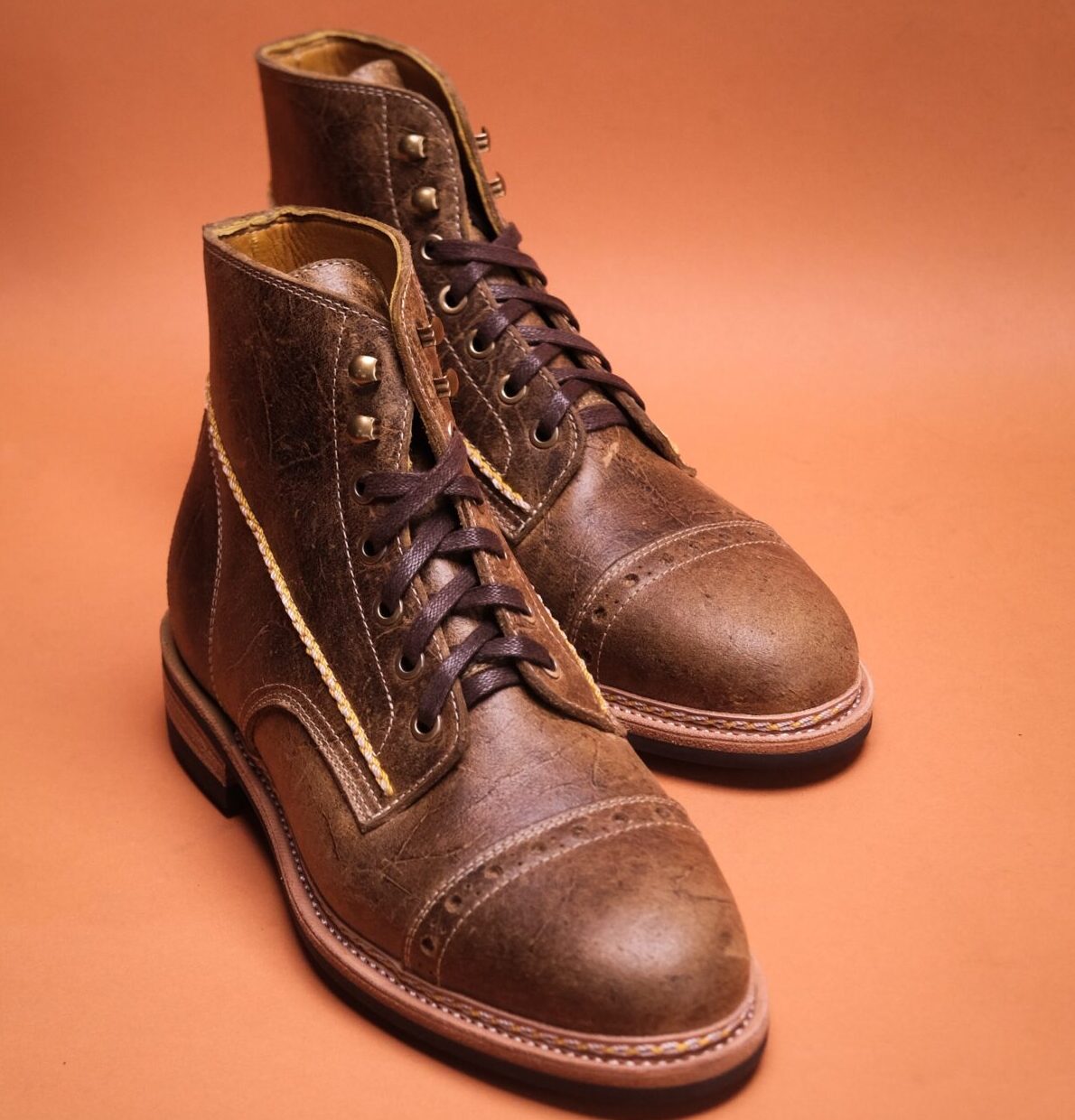
There is a reason the same word keeps coming up whenever serious boot buyers talk about quality: construction. Not the leather, not the brand, not the colour. How the thing is actually held together. And among construction methods, handwelting sits at the top of the conversation, even though it is older, slower, and more expensive than almost everything else on the market.
So why does it still matter in 2026, when faster methods exist and most footwear is glued together? TXTURE builds certain models, like the Tanka Boots, with full handwelted construction for reasons that go well past tradition. Here are six of them.
1. Handwelted, Goodyear, and Cemented Are Not the Same Thing
Before anything else, it helps to know what the alternatives actually are, because the word “welt” gets thrown around loosely.
A cemented boot has its sole glued to the upper. It is fast and cheap, and it is what most shoes in the world use. The catch is that once that glue bond fails, the boot is more or less finished. A Goodyear welt stitches a strip of leather, the welt, to the upper and insole by machine, then stitches the sole to that welt. It is robust, repairable, and the backbone of most quality boot lines, TXTURE included. Handwelting does the same job as Goodyear, but the welt is sewn entirely by hand rather than by a machine. That is the headline difference, and everything below flows from it.
2. The Awl-and-Thread Part Is the Hard Part
Handwelting is not difficult to describe and very difficult to do. An artisan drives an awl through thick leather, threads waxed thread through the hole by hand, draws it tight, and moves on to the next stitch. They do this around the full perimeter of the boot, every stitch placed and tensioned by a person.
A single pair can take hours at this stage alone. There is no shortcut that preserves the result, which is exactly why so few makers offer it. It demands a skilled hand and a lot of patience, and you cannot fake either. When you pay for a handwelted boot, a large slice of that price is simply the human time locked inside the welt.
3. Welted Boots Can Be Resoled, Again and Again
This is the practical payoff most buyers care about. Because the sole is stitched to a welt rather than glued straight to the upper, a cobbler can remove a worn sole and stitch on a fresh one without tearing the boot apart.
A cemented shoe rarely survives that process. A welted boot is designed for it. With periodic resoling, a good pair can stay in rotation for years, sometimes decades, long after a glued equivalent would have hit the bin. That changes the maths entirely. A boot that costs more upfront but lasts three or four times as long is not the expensive option. It is usually the cheaper one over its full life.
4. Structure That Holds Its Shape
Welted construction does something subtler too. The welt and the stitching give the boot a built-in structural frame, so it keeps its shape over time instead of collapsing softly the way many glued shoes do.
You feel this in how the boot wears. The sides stay supported, the sole stays flat, the silhouette stays clean. Pair that with a properly chosen last and a firm insole, and the boot ages into your foot without going shapeless. It is the difference between a pair that looks better after two years and one that looks tired.
5. This Is Why Handwelted Boots Stay Rare
Put points two through four together and the scarcity explains itself. Handwelting cannot be rushed, cannot be fully automated, and depends on artisans who have spent years getting good at it. A workshop can only turn out so many pairs without dropping the standard.
That is why handwelted boots, from Bandung and everywhere else, tend to come in limited numbers. TXTURE treats this as a feature rather than a problem to engineer away. Reserving full handwelting for specific models keeps the work honest and the quality where it should be, rather than stretching a skilled team past the point where the method still means something.
6. How to Tell If a Boot Is Actually Welted
Marketing language is slippery, so it helps to know what to look for. Flip a boot over. A welted boot shows stitching running around the edge of the sole, where the sole meets the welt. On a cemented shoe that stitching is absent, or it is purely decorative and stitched into nothing.
Ask the maker directly whether a model is handwelted, Goodyear welted, or cemented, and a serious one will answer plainly. Look at whether the boot can be resoled at all, since that is the real-world test of the construction. With TXTURE, the construction method is part of the product information rather than something buried, which is generally a good sign in any boot brand worth your money.
Construction You Can Feel Years Later
Handwelted boots matter for an unglamorous reason: they last, they can be repaired, and they hold their shape while doing it. The hours of hand-stitching that go into the welt are not nostalgia. They are what lets a pair stay with you long enough to actually break in, age, and become yours. In a throwaway market, that is the whole argument, and it is a strong one.