Underground mining sits at the high end of operational risk in Indonesian extractive industries. The hazard profile is layered: confined space, ventilation dependency, geological instability, mobile equipment in restricted clearance, fire and explosion exposure, water inrush. Surface operations don’t carry this combination. Workplace safety underground depends on training, planning, and emergency response capabilities that conventional methods only partially deliver.
This article looks at how VR Digital Twin technology applies to underground mining safety in Indonesia. The framing is a case study structure — operational logic of how the technology fits real underground requirements, which specific safety problems it addresses, and the way Indonesian regulation shapes implementation.
The Indonesian Underground Mining Context
Underground mining in Indonesia spans several material categories. Coal operations cluster in East Kalimantan and parts of Sumatra. Hard rock metal mining (copper, gold, nickel, and other commodities) is also active; Grasberg in Papua is one of the largest underground operations globally. Industrial minerals and quarrying account for the remainder. Operational profiles differ across these categories, but the underlying safety challenges share common structural features.
Underground operations are spatially complex. Tunnel networks reach kilometers from surface access points. Levels are linked through ramps, shafts, and ventilation infrastructure. Personnel and equipment move through tight clearances. The physical environment changes continuously as mining advances.
Ventilation dependency is absolute. Active ventilation has to remove dust, diesel emissions, blast fumes, and mine gases — methane, carbon monoxide, hydrogen sulfide, varying by deposit type. When ventilation fails, the workplace shifts from operational to life-threatening within minutes.
Emergency response is harder than surface response, geometrically so. Distance from working area to surface, restricted egress routes, communication difficulties in deep workings, atmospheric hazards, and the time needed to reach affected areas all extend the consequences of any incident.
The regulatory framework reflects this risk profile. Indonesian underground mining operates under Permen ESDM No. 26 Tahun 2018 on K3 Pertambangan, with related instruments: Kepmen ESDM No. 1827 K/30/MEM/2018 on technical mining standards, Kepmen ESDM No. 1806 K/30/MEM/2018 on mining plan requirements, and sector-specific implementation rules from Direktorat Jenderal Mineral dan Batubara (Minerba). Workplace safety standards covering ventilation design, emergency response capability, training competency for underground personnel, and incident reporting requirements all live within this framework.
Physical complexity plus regulatory rigor creates specific gaps. That’s where VR Digital Twin produces operational value.

Where VR Digital Twin Fits in Underground Mining Safety
Underground mining safety applications usually combine elements of several Digital Twin types — Analytics, Asset, Process, and System Twins — with VR functioning as the immersive interface for training, planning, and scenario rehearsal.
This combination matters. Underground mining safety needs both data accuracy (which the Digital Twin handles) and experiential learning (which VR handles). Neither piece closes the gap by itself.
A few specific applications carry direct safety value.
Mine layout familiarization. New personnel have to learn the layout — tunnel configuration, level access, ventilation infrastructure, emergency exits, refuge chambers, communication systems. Conventional familiarization uses paper maps, supervised walkthroughs, and on-the-job exposure. VR-based familiarization with an accurate Digital Twin lets personnel walk the layout repeatedly before stepping into the real workplace. Pattern recognition builds faster, and emergency egress routes get reinforced before they’re needed under pressure.
Hazard recognition training. Identifying ground instability indicators, reading ventilation degradation symptoms, spotting equipment hazards, picking up environmental cues that precede incidents — these are perceptual skills that develop through repeated exposure. Live environments offer exposure, but on uncontrolled timing, and missed cues can be costly. VR scenarios using accurate Digital Twin environments let personnel practice hazard recognition across a wider range of conditions than any single shift would produce, with the option to see consequences of missed cues without actual harm.
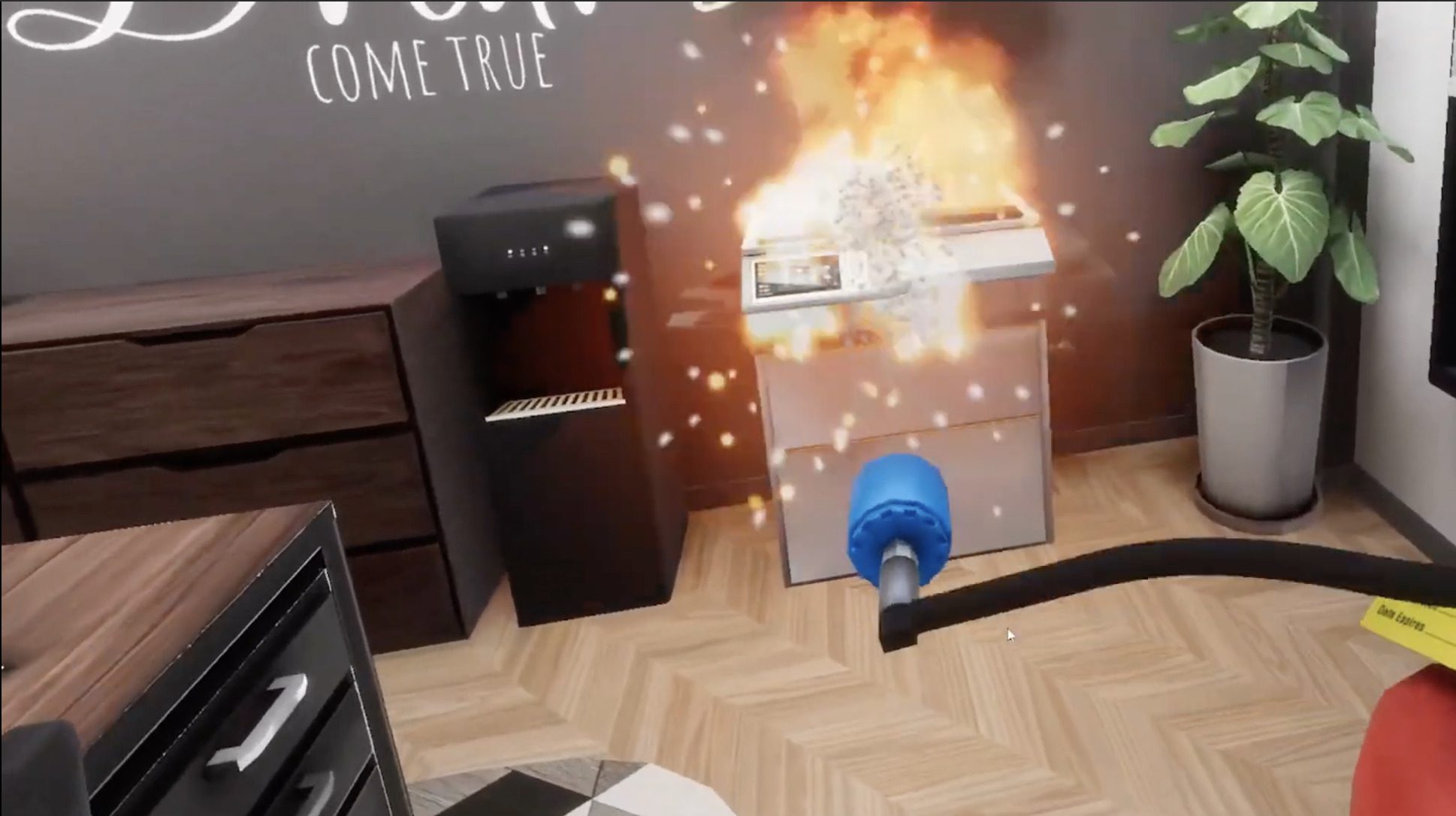
Emergency response and self-rescue training. Self-Contained Self-Rescuer (SCSR) deployment, emergency egress under reduced visibility, refuge chamber procedures, communication during incidents, coordination with mine rescue teams. All of these need repetition. Live drills face limits: operational schedule, safety overhead, restricted variety. VR integrated with the Digital Twin runs these scenarios across the full mine layout, with simulated atmospheric conditions, equipment failures, and timing pressures that aren’t safe to replicate live.
Ventilation modeling and education. Underground ventilation is mathematically complex. Air flow distribution, pressure differentials, contamination dispersion, the way operational changes shift ventilation patterns — this is hard to convey through traditional training materials. Digital Twin platforms with embedded ventilation models let personnel see how the system actually behaves, including how it reacts to fan failures, shaft openings, blast events, and emergency procedures.
Emergency planning and rehearsal. Site-specific emergency response procedures benefit from rehearsal inside the actual mine environment. Mine rescue teams, emergency response coordinators, supervisory personnel — all of them can use the Digital Twin to walk through specific scenarios. Fires at particular locations. Ventilation failures. Casualty extraction from specific working areas. Refining procedures before the actual emergency.
Operator training for underground equipment. Heavy equipment underground works under different conditions than surface equipment. Clearance constraints, ventilation requirements, ground support interaction, emergency procedures — all different. VR-based operator familiarization using the Digital Twin lets operators learn the specific workplace before entering the cabin underground.

A Typical Implementation Framework
For Indonesian underground operations evaluating VR Digital Twin for safety applications, implementation usually moves through a structured sequence.
Phase 1: Site digitization. The physical mine gets captured into digital form. Methods include LIDAR scanning, photogrammetry, integration of existing CAD and survey data, plus modeling of infrastructure components. Output is a spatially accurate digital representation of layout, infrastructure, and ventilation system. For active mines, digitization works around ongoing operations and reflects the mine’s evolving geometry.
Phase 2: System integration. Operational data sources get pulled into the twin. Atmospheric monitoring sensors (gas detection, ventilation flow, temperature), equipment telematics, dispatch system integration, personnel tracking, survey updates — all feeding the twin’s real-time state. Integration depth varies by what digital infrastructure already exists and which safety applications are being targeted.
Phase 3: VR training scenario development. Specific safety training scenarios are built using the Digital Twin as the spatial environment. Scope follows actual operational priorities: high-risk activities, identified hazard categories, emergency procedures, regulatory training requirements. Scenarios are validated against the operation’s K3 Pertambangan documentation and the relevant Permen ESDM standards.
Phase 4: Pilot deployment. Initial deployment targets a defined user group and scenario set, not full-scale rollout. Common starting points: new-hire orientation, refresher training for existing personnel, mine rescue team rehearsal, supervisory training. Pilot results shape how expansion gets approached.
Phase 5: Scaled deployment. Successful pilots expand into broader workforce coverage, additional scenario types, and integration with existing training infrastructure. The Digital Twin is maintained as the mine evolves — periodic updates reflecting mine plan changes, infrastructure modifications, operational developments.
Phase 6: Continuous evolution. Mature deployments fold the Digital Twin into ongoing safety management. Incident analysis uses the twin to reconstruct events. Mine plan changes get validated through simulation before implementation. Emergency response procedures evolve as the mine layout changes. At this stage, the twin functions as operational infrastructure, not a discrete training tool.
This sequencing matches what most successful Digital Twin programs in mining follow. It also fits the realistic budget cycles and organizational change capacity of large mining operations.
Specific Safety Problems VR Digital Twin Addresses
Pulling the framework together gives a clearer picture of which safety problems VR Digital Twin actually addresses.
Spatial disorientation in emergencies. Personnel who haven’t practiced the egress route from their working area to surface — under reduced visibility, under stress — carry higher risk during real emergencies. VR rehearsal with accurate Digital Twin environments closes this gap.
Inadequate scenario variety in emergency training. Conventional drills cover whatever the operation can physically stage. VR drills cover whatever the simulation supports: fires at specific locations, ventilation failures, equipment incidents, casualty extractions across the full mine geometry.
Limited exposure to high-consequence scenarios. Mine fires, gas events, water inrush, major ground instability — catastrophic when they occur, rare in routine operations. Personnel can finish careers without ever rehearsing response to these events under realistic conditions. VR provides the rehearsal opportunity.
Skill decay in low-frequency response procedures. Self-rescue, refuge chamber procedures, emergency communication — none of these get practiced often in live operations. Skills degrade. VR enables higher-frequency rehearsal at low marginal cost, addressing a retention problem that conventional training can’t solve.
Cross-site consistency for multi-site operations. Mining companies running multiple underground sites face the challenge of consistent safety training quality across geographically distributed operations. VR Digital Twin programs deliver standardized scenario quality without instructors traveling between sites.
Audit and competency documentation. K3 Pertambangan requirements include documentation of personnel competency for safety-critical activities. VR session telemetry generates auditable competency records that supplement attendance documentation, supporting compliance with Direktorat Jenderal Minerba audit requirements.
Mine rescue team capability. Mine rescue teams need specialized training that’s expensive and operationally demanding to deliver through live exercises alone. VR Digital Twin adds rehearsal frequency for high-stakes scenarios these teams must be ready for, complementing existing training infrastructure rather than replacing it.
These applications produce direct operational value for Indonesian underground mining. They also align with safety culture improvements that Direktorat Jenderal Minerba and operational leadership at major Indonesian mining companies have been working toward over recent years.
Where VR Digital Twin Doesn’t Replace Existing Safety Infrastructure
Worth being direct about the limits.
VR Digital Twin doesn’t replace certified mine rescue training. Mine rescue capability needs physical training with actual equipment, in conditions that test personnel’s physical capacity alongside procedural knowledge. VR supplements rescue training. It doesn’t substitute.
It doesn’t replace ventilation engineering either. The mathematical models embedded in the twin support training and operational understanding, but ventilation design and management stay with qualified ventilation engineers operating under regulatory standards.
Ground control engineering is the same case. Underground stability assessment, ground support design, geotechnical monitoring — these require specialized engineering capability that the twin can visualize but cannot replace.
Required certifications also stay outside the VR pipeline. Underground supervisor certifications, blaster qualifications, mine emergency response certifications, equipment operator licensing — all of these run through accredited certification pathways. VR is part of the training pipeline that prepares personnel for these certifications, not an alternative path.
And site-specific risk assessment remains operational work. Pre-shift inspections, daily operational planning, active management of changing conditions — these are responsibilities of supervisors and competent persons on site.
A cleaner framing: VR Digital Twin fills specific safety capability gaps that conventional methods cannot cost-effectively close. Scenario variety, practice frequency, high-consequence rehearsal, competency documentation. It works alongside existing safety infrastructure, not in place of it. The error to avoid is treating VR Digital Twin as a complete safety program on its own.
Practical Considerations for Indonesian Underground Mining Operators
Several factors affect how successfully VR Digital Twin programs deploy in Indonesian underground mining.
Site digitization quality determines twin quality. The Digital Twin is only as accurate as the source data. Operations with mature survey practices, current CAD documentation, and disciplined as-built records produce more accurate twins, faster, than operations working from outdated documentation.
Sensor infrastructure determines twin liveness. Real-time twin functionality depends on operational data feeds. Operations with mature gas monitoring, ventilation sensing, and equipment telematics integrate more readily than operations starting from limited sensor coverage.
Bahasa Indonesia content matters operationally. Underground mining workforces in Indonesia are predominantly Indonesian-speaking. VR scenarios with Bahasa Indonesia voice prompts, signage, and instruction fit into existing training programs more cleanly than English-only imported content.
Local engineering presence supports sustained value. Digital Twins evolve as mines evolve. Programs supported by local engineering teams adapt to ongoing operational changes. Programs dependent on remote international support tend to drift out of date over time.
K3 Pertambangan compliance integration matters. Programs designed with Permen ESDM No. 26 Tahun 2018 requirements built in from the start integrate with audit and compliance workflows more cleanly than programs requiring retrofit alignment after deployment.
Procurement timing matters. Underground mining operations have specific budget cycles, capital approval processes, and operational windows. Programs that align with these realities deploy more successfully than programs that ignore them.
These considerations apply broadly across major Indonesian underground mining operators. Each operation has specific circumstances that affect implementation. The structural factors above show up consistently.
Virtu is an Indonesian XR and Industry 4.0 company with a substantial portfolio in mining technology. The company’s mining client base includes BUMA (Bukit Makmur Mandiri Utama), PAMA, Petrosea, United Tractors, and Indo Tambangraya Megah — covering major segments of the Indonesian mining sector.
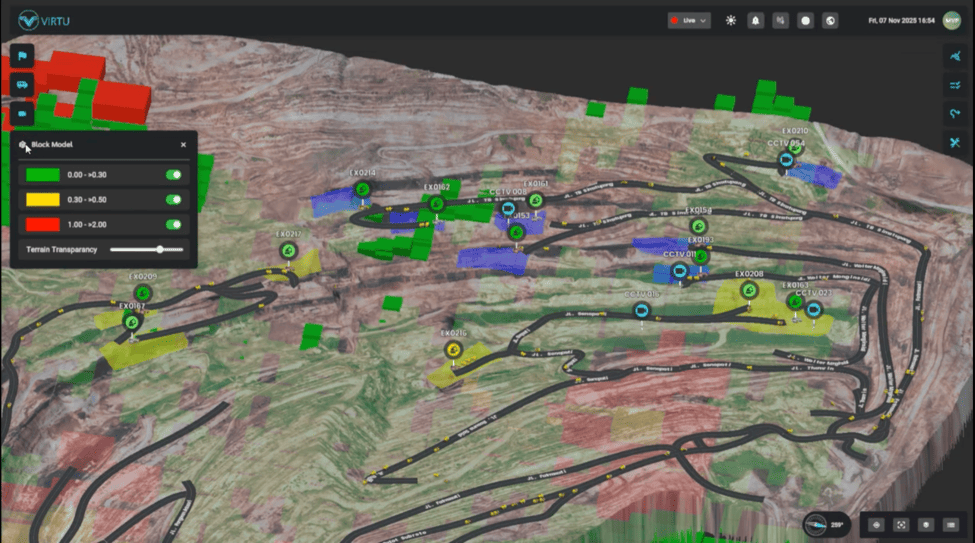
Featured Digital Twin work includes Smart Digital Twin Mining for coal mine operations, which visualizes complex terrain, vehicle data, and analytical layers in interactive platforms. The same platform infrastructure supports Heavy Duty Mining Vehicles VR Training for operator familiarization, working at height safety scenarios, and other industrial training applications relevant to mining work.
Virtu’s process for Digital Twin engagements moves through four stages: Diagnose (understanding the operational requirement and matching twin scope to actual gap), Design (architecting the twin and integration approach), Develop (building the twin and integrating with operational systems), and Deploy (installation, testing, training for operational handover).
The company is Indonesian-based, with engineering and project delivery capacity in-country — which matters for Digital Twin work that requires sustained collaboration with site operations, IT teams, and operational stakeholders. Voice prompts and UI default to Bahasa Indonesia, with English available for multinational operations. Implementation work for underground mining applications can be scoped to address site-specific safety priorities, integrate with existing K3 Pertambangan documentation, and align with the operation’s ESDM compliance requirements.
For Digital Twin scoping conversations, capability briefings, or pilot deployments specifically focused on underground mining safety, Virtu can be reached through the contact form at https://virtu.co.id/ or via WhatsApp at +62 812 9696 7887.